
Stocks are near record highs, bond yields just touched their highest level since 2002, and the calendar is running out on several 2026 tax opportunities. That combination makes this a particularly good year to review your portfolio before the ball drops. Here is a practical checklist.
Why This Year-End Is Different
2026 has pulled stocks and bonds in opposite directions. The S&P 500 set a record close of 7,818.93 on October 6 and was up roughly 12.7% for the year as of October 20. Over the same stretch, the bond market sold off: the 10-year Treasury yield climbed above 5.3% in early October, its highest level since 2002, after the Federal Reserve raised its benchmark rate to 3.75%–4.00% in September amid renewed inflation pressure.
Because bond prices move opposite to yields, many bond funds are showing losses this year while stock funds are showing gains. That leaves two practical consequences for investors: portfolios have likely drifted away from their targets, and there may be losses worth putting to work at tax time.
1. Rebalance Back to Your Target
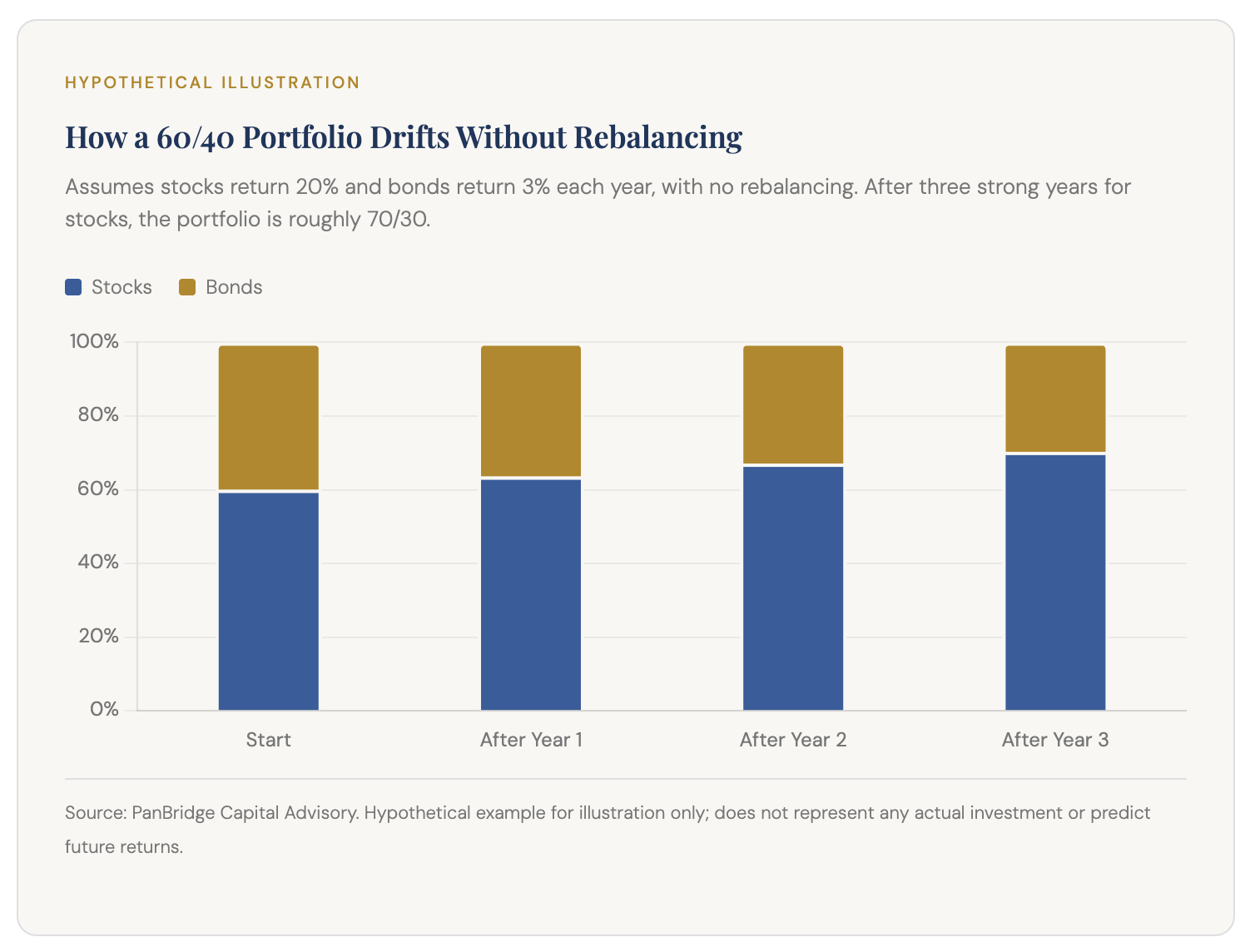
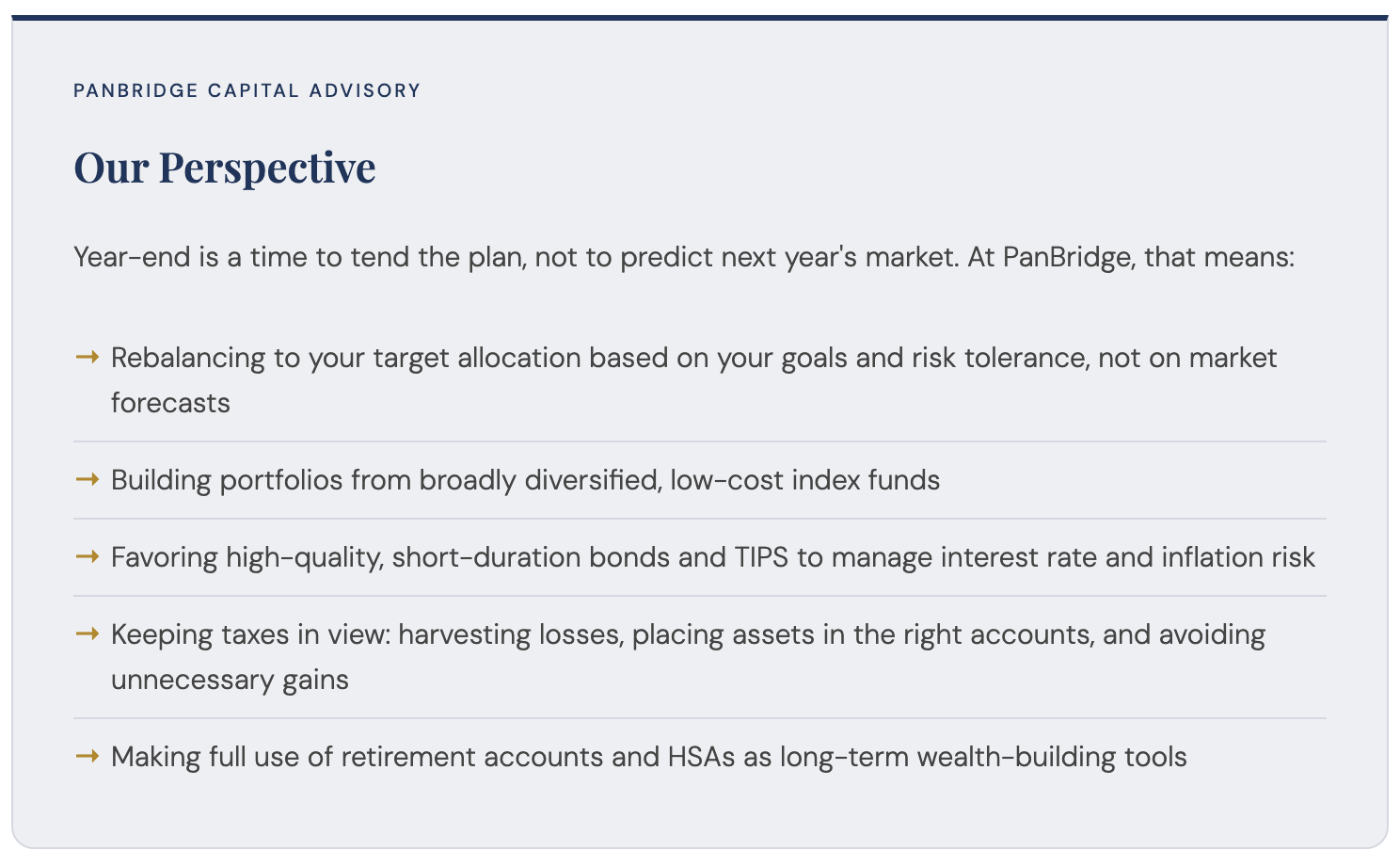
A target allocation, such as 60% stocks and 40% bonds, reflects the level of risk you decided you can live with. When stocks outperform, that mix quietly shifts. Left alone for a few strong years, a "moderate" portfolio can end up carrying far more stock market risk than intended.
Rebalance inside retirement accounts first. Selling and buying within a 401(k), IRA, or HSA does not trigger capital gains taxes, so it is usually the cleanest place to bring your allocation back in line.
Use new money before selling. Directing new contributions or dividends toward the underweight asset can close the gap without realizing gains in a taxable account.
Set a tolerance band. Many investors rebalance only when an asset class drifts more than about five percentage points from target. That keeps trading, and taxes, to a minimum.
2. Harvest Losses, Especially in Bonds
Tax-loss harvesting means selling an investment that is worth less than you paid for it in a taxable account, then using that realized loss to offset gains. Realized losses first offset capital gains; up to $3,000 a year of any remaining loss can offset ordinary income, and anything left over carries forward to future years.
“A losing bond fund in a taxable account isn’t only a disappointment. At year-end, it can be a tax asset.”
With yields at multi-decade highs, bond index funds purchased in prior years may be sitting below their cost basis. Harvesting those losses can offset gains from rebalancing your stock holdings.
Mind the wash-sale rule. If you buy the same or a "substantially identical" investment within 30 days before or after the sale, the loss is disallowed, and that includes purchases in your IRA or your spouse's accounts. Index investors often stay invested by switching to a similar fund that tracks a different index, then reviewing the position after the 30-day window.
3. Make the Most of Tax-Advantaged Accounts
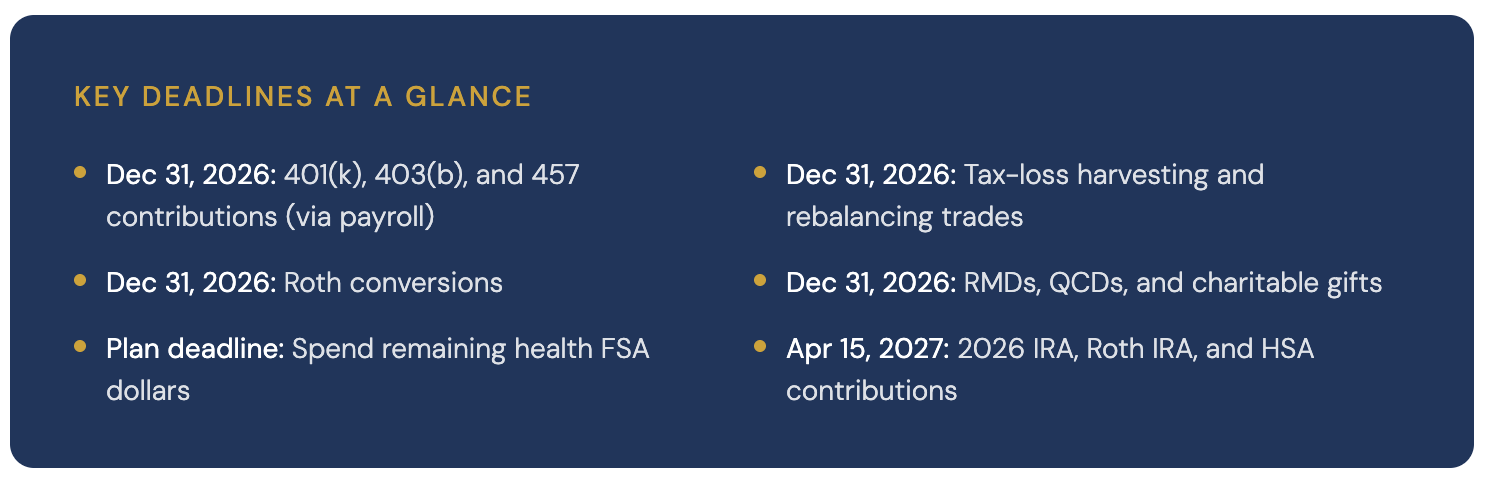
Contribution limits are "use it or lose it" each year. For most workplace plans, the deadline is your last paycheck of 2026, so review your remaining pay periods now. IRA and HSA contributions for 2026 can be made until April 15, 2027.
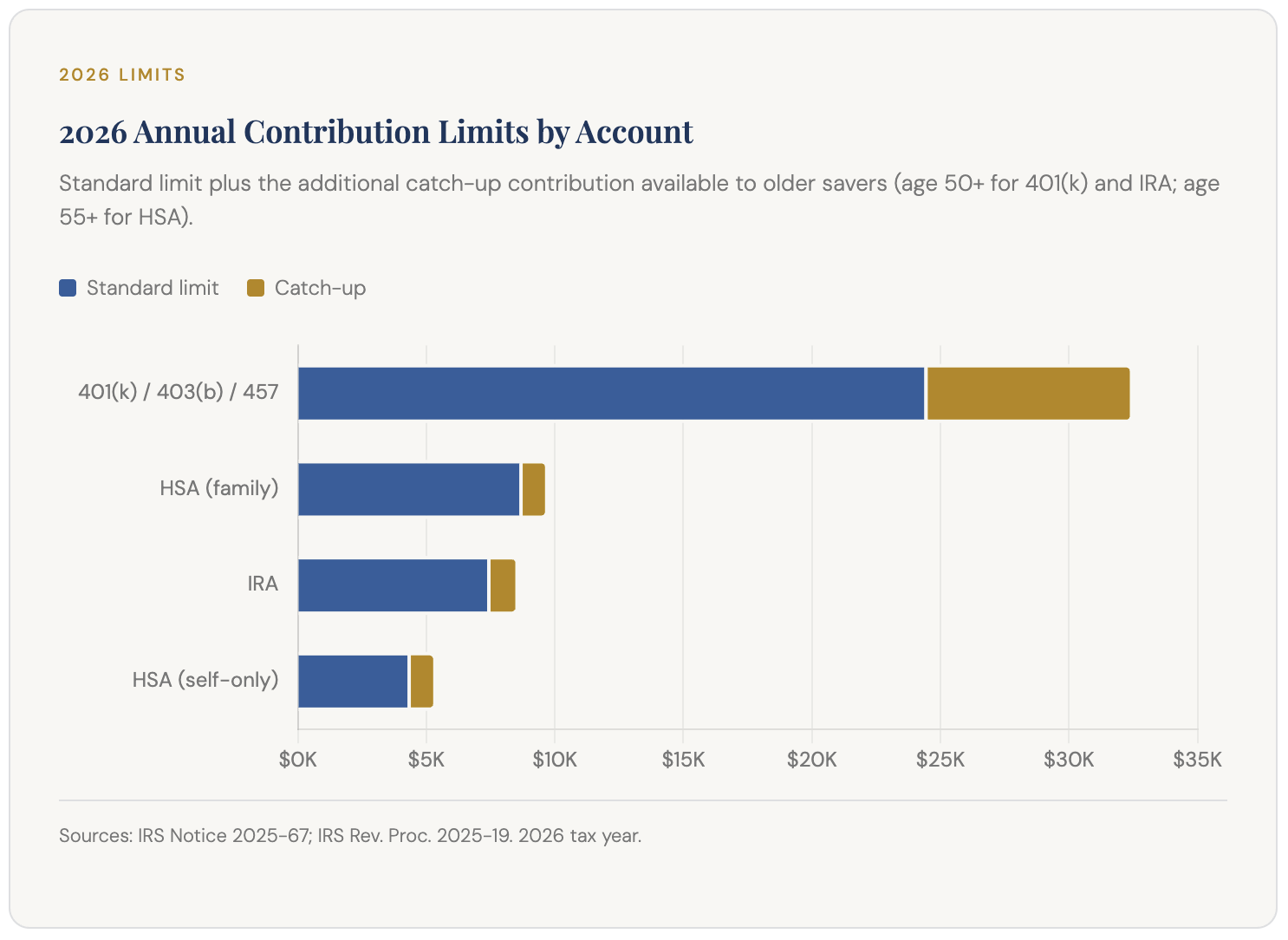
Ages 60 to 63: a higher "super catch-up" of $11,250 applies in most 401(k), 403(b), and governmental 457 plans, in place of the $8,000 catch-up.
Higher earners: starting in 2026, if your 2025 FICA wages from your employer exceeded $150,000, any catch-up contributions must go in as Roth (after-tax) contributions. Check that your plan is set up to handle this.
Your HSA counts too. Invested in low-cost index funds, a Health Savings Account offers a triple tax advantage: deductible contributions, tax-free growth, and tax-free withdrawals for qualified medical expenses. For many households, it is one of the most efficient long-term savings vehicles available.
4. Consider a Roth Conversion
Converting part of a traditional IRA to a Roth IRA means paying income tax now in exchange for tax-free growth and withdrawals later. Conversions must be completed by December 31 to count for 2026, and they tend to make the most sense in years when your income is lower than usual, such as after retirement but before Social Security and required distributions begin.
Two cautions: pay the tax from money outside the IRA if you can, and remember that a larger income this year can raise Medicare premiums two years later for those on or near Medicare. A partial conversion that "fills up" your current tax bracket is often a measured approach.
5. Take Required Distributions and Give Strategically
Required minimum distributions (RMDs) generally apply starting at age 73. Missing one triggers a 25% excise tax on the amount not withdrawn (reduced to 10% if corrected promptly), so confirm yours is scheduled before December 31.
Qualified charitable distributions (QCDs) let IRA owners age 70½ and older give directly from an IRA to charity, up to $111,000 in 2026. A QCD can count toward your RMD and is excluded from taxable income, which is often more valuable than a deduction.
New charitable rules for 2026
The One Big Beautiful Bill Act changed charitable giving starting this year. Taxpayers who take the standard deduction can now deduct up to $1,000 (single) or $2,000 (married filing jointly) in cash gifts to qualifying public charities. Itemizers face a new floor: only giving above 0.5% of adjusted gross income is deductible, and for those in the top 37% bracket, the deduction's value is capped at 35%. "Bunching" several years of gifts into a single year, or using a donor-advised fund, may help larger donors work around the floor.
6. Don't Leave Benefits Money Behind
Health care Flexible Spending Account (FSA) balances are largely use-it-or-lose-it. Depending on your employer's plan, you may have a short grace period or a limited carryover, but not both. Check your plan's deadline and use remaining funds on eligible expenses. And if you're in the middle of open enrollment, revisit your elections rather than letting them renew by default.
Markets will do what they do in 2027. What investors can control is how their portfolio is positioned, how much they save, and how much they keep after taxes. A focused hour of year-end review can pay off for years to come.
Educational content only. Not investment, tax, or legal advice. Past performance does not guarantee future results. Tax rules are complex and depend on individual circumstances; consult a qualified tax professional before acting on any strategy discussed here. Consult a qualified financial professional for guidance tailored to your specific situation and objectives.

Sources: Internal Revenue Service (Notice 2025-67; Rev. Proc. 2025-19), CNBC, Forbes, Macrotrends, Kiplinger, Vanguard Charitable. Market data as of October 20, 2026.